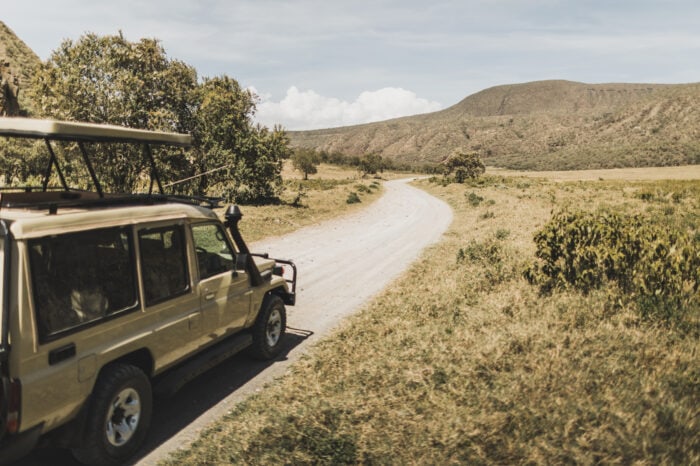
Der Aberdare Nationalpark besitzt eine Fläche von 766 km². Er liegt in der unmittelbaren Umgebung der Nyandaruaberge und besteht aus der Aberdare Range, einer Bergkette vulkanischen Ursprungs, die sich von Norden nach Süden erstreckt, sowie deren östlichen, dicht bewaldeten Vorgebirgen.
Zwischen den beiden größten Erhebungen, Ol Donyo Lesatima (auch Ol Doinyo La Satima; 3999 m) und Kinangop (3906 m), verläuft auf einer Höhe von über 3000 m ein Sattel alpiner Heidelandschaft. Neben den hoch gelegenen Moorgebieten kommen Buschland und Bergwald einschließlich Bambus vor. Schluchten mit Bächen und Wasserfällen durchtrennen bewaldete Hänge im Osten und Westen. Es ist ein wichtiges Wassereinzugsgebiet für den Tana- und Athi-River.
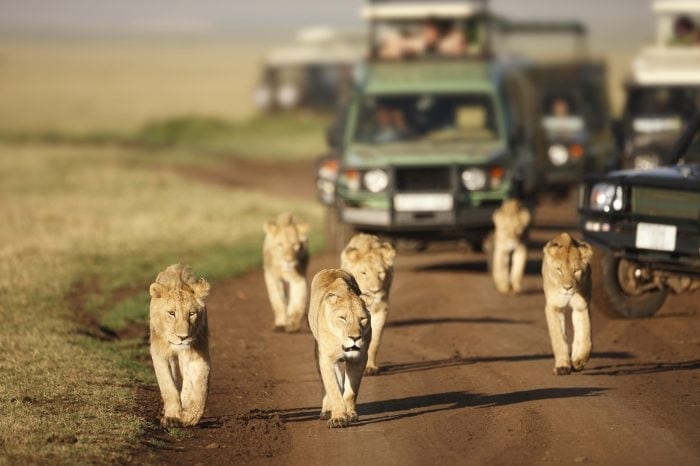
Im Nationalpark kann man auf Safari gehen, sie muss aber geführt sein. Auch Camps und Lodges sind im Nationalpark vorhanden. Besondere Attraktionen des Parks sind die Wasserfälle Karuru, Gura, Chania und Magura
Das Wetter ist zum größten Teil des Jahres von Nebel und Regen geprägt. Häufig treten schwere Regenfälle, mit Niederschlagsmengen zwischen 1000 mm pro Jahr an den nordwestlichen Hängen sowie 3000 mm pro Jahr im Südosten, auf.
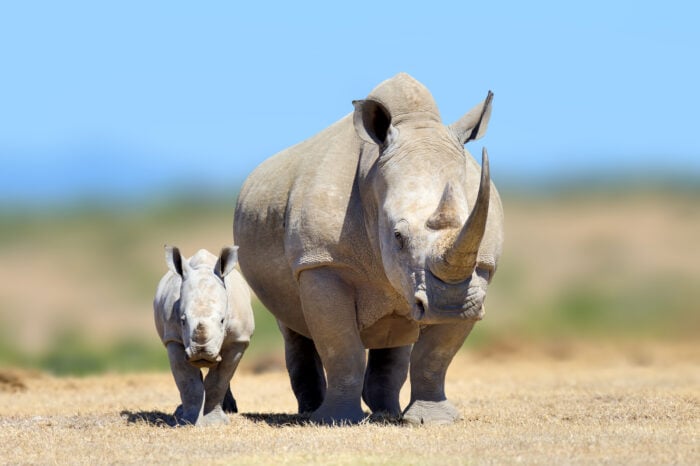
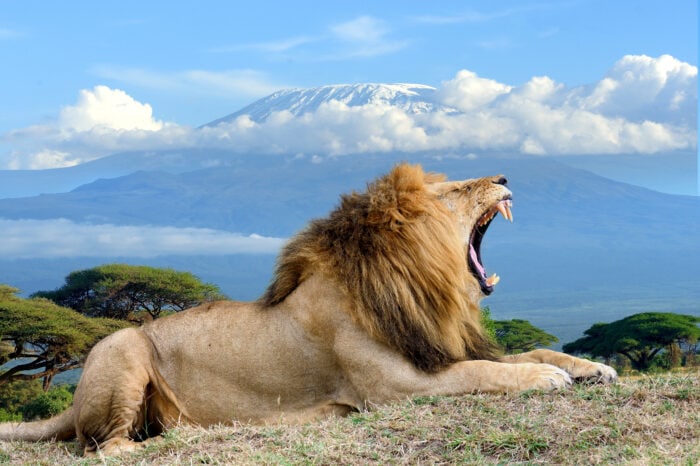
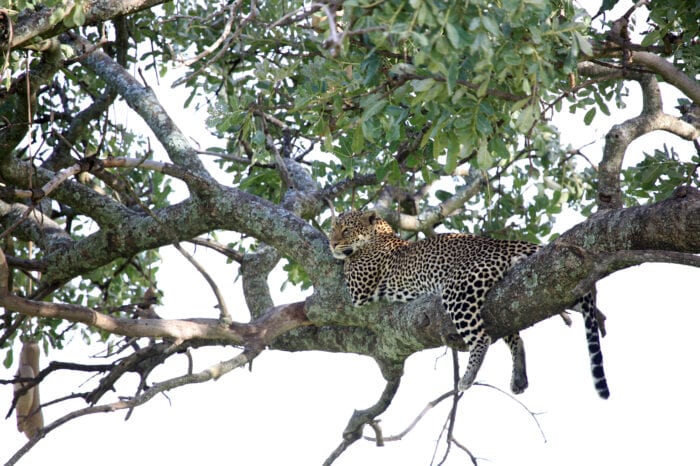
Die Tierwelt ist nicht besonders artenreich. Es gibt Bongos, Büffel, Busch- und Wasserböcke sowie Busch- und Riesenwaldschweine. Das Spitzmaulnashorn ist hier noch nicht völlig ausgerottet. Mit etwas Glück kann man auch schwarze Panther (schwarz gefärbte Leoparden) zu Gesicht bekommen.
Die Elefanten auf der Höhe der Nyandaruaberge sind recht scheu. Sie nutzen die Bambus-, Baumheide- und sonstigen dichten Buschbestände als Deckung. Im Salient genannten Ostteil des Parkes, um die Lodges Treetops und The Ark herum, sind die Elefanten an Menschen gewöhnt. 1973 und 1976 sollen im Aberdare-Nationalpark 3000 Elefanten gelebt haben, 1987 waren es noch 2000 Tiere. Die Wilderei ist unter Kontrolle. Tiefe Gräben hindern die Elefanten am Verlassen des Parkes, da sie in den außerhalb gelegenen besiedelten und landwirtschaftlich genutzten Gebieten verfolgt werden würden.
The Aberdare National Park has an area of 766 km². It is situated in the immediate vicinity of the Nyandarua Mountains and consists of the Aberdare Range, a mountain range of volcanic origin that stretches from north to south, and its eastern, densely forested foothills.
Between the two largest elevations, Ol Donyo Lesatima (also Ol Doinyo La Satima; 3999 m) and Kinangop (3906 m), a saddle of alpine heathland runs at an altitude of over 3000 m. In addition to the high moorland areas, bush land and mountain forest including bamboo can be found. Gorges with streams and waterfalls cut through wooded slopes in the east and west. It is an important water catchment area for the Tana and Athi rivers.
You can go on safari in the national park, but it must be guided. There are also camps and lodges in the national park. Special attractions of the park are the waterfalls Karuru, Gura, Chania and Magura
For most of the year the weather is characterized by fog and rain. Heavy rainfall is frequent, with rainfall of between 1000 mm per year on the north-western slopes and 3000 mm per year in the south-east.
The fauna is not particularly rich in species. There are bongos, buffalos, bushbucks and waterbucks as well as bush and giant forest pigs. The black rhino is not yet completely extinct here. With a bit of luck you can also see black panthers (black colored leopards).
The elephants at the height of the Nyandarua Mountains are quite shy. They use the bamboo, tree heather and other dense bushes as cover. In the eastern part of the park called Salient, around the lodges Treetops and The Ark, the elephants are used to humans. In 1973 and 1976, 3000 elephants are said to have lived in Aberdare National Park, in 1987 it was 2000 animals. Poaching is under control. Deep ditches prevent the elephants from leaving the park, as they would be pursued in the outlying populated and agricultural areas.
Le parc national d’Aberdare a une superficie de 766 km². Il est situé à proximité immédiate des montagnes de Nyandarua et se compose de la chaîne d’Aberdare, une chaîne de montagnes d’origine volcanique qui s’étend du nord au sud, et de ses contreforts orientaux densément boisés.
Entre les deux plus grandes altitudes, Ol Donyo Lesatima (aussi Ol Doinyo La Satima ; 3999 m) et Kinangop (3906 m), un sillon de landes alpines s’étend à plus de 3000 m d’altitude. En plus des zones de landes élevées, on trouve des zones de brousse et de forêt de montagne, y compris des bambous. Des gorges avec des ruisseaux et des chutes d’eau traversent des pentes boisées à l’est et à l’ouest. Il s’agit d’un important bassin versant pour les rivières Tana et Athi.
Vous pouvez faire un safari dans le parc national, mais il doit être guidé. Il y a aussi des camps et des gîtes dans le parc national. Les attractions spéciales du parc sont les chutes d’eau Karuru, Gura, Chania et Magura.
Pendant la majeure partie de l’année, le temps est caractérisé par le brouillard et la pluie. Les pluies abondantes sont fréquentes, avec des précipitations comprises entre 1000 mm par an sur les pentes du nord-ouest et 3000 mm par an dans le sud-est.
La faune n’est pas particulièrement riche en espèces. Il y a des bongos, des buffles, des bushbucks et des waterbucks ainsi que des cochons de brousse et des cochons de forêt géants. Le rhinocéros noir n’est pas encore complètement éteint ici. Avec un peu de chance, vous pouvez aussi voir des panthères noires (léopards de couleur noire).
Les éléphants à la hauteur des montagnes Nyandarua sont assez timides. Ils utilisent le bambou, la bruyère arborescente et d’autres buissons denses comme couverture. Dans la partie orientale du parc appelée Salient, autour des lodges Treetops et The Ark, les éléphants sont habitués aux humains. En 1973 et 1976, 3000 éléphants auraient vécu dans le Parc National d’Aberdare, en 1987 c’était 2000 animaux. Le braconnage est sous contrôle. Des fossés profonds empêchent les éléphants de quitter le parc, car ils seraient poursuivis dans les zones périphériques peuplées et agricoles.
Il Parco Nazionale di Aberdare ha una superficie di 766 km². Si trova nelle immediate vicinanze dei monti Nyandarua ed è costituito dalla catena montuosa di Aberdare, una catena montuosa di origine vulcanica che si estende da nord a sud, e dalle sue propaggini orientali, densamente boscose.
Tra le due alture più grandi, Ol Donyo Lesatima (anche Ol Doinyo La Satima; 3999 m) e Kinangop (3906 m), una sella di brughiera alpina corre ad un’altitudine di oltre 3000 m. Oltre alle zone di brughiera alta, si possono trovare anche zone di macchia e foreste di montagna, tra cui il bambù. Gole con ruscelli e cascate tagliano i pendii boschivi a est e a ovest. È un importante bacino idrografico per i fiumi Tana e Athi.
Si può fare un safari nel parco nazionale, ma deve essere guidato. Ci sono anche campi e lodge nel parco nazionale. Attrazioni speciali del parco sono le cascate Karuru, Gura, Chania e Magura.
Per la maggior parte dell’anno il tempo è caratterizzato da nebbia e pioggia. Le piogge abbondanti sono frequenti, con precipitazioni tra i 1000 mm all’anno sui pendii nord-occidentali e i 3000 mm all’anno nel sud-est.
La fauna non è particolarmente ricca di specie. Ci sono bonghi, bufali, bushbuck e waterbucks, oltre a bush e maiali giganti della foresta. Il rinoceronte nero non è ancora completamente estinto. Con un po’ di fortuna si possono vedere anche le pantere nere (leopardi di colore nero).
Gli elefanti all’altezza dei monti Nyandarua sono piuttosto timidi. Usano il bambù, l’erica e altri cespugli densi come copertura. Nella parte orientale del parco chiamato Salient, intorno ai lodge Treetops e all’Arca, gli elefanti sono abituati agli esseri umani. Nel 1973 e 1976, si dice che nel Parco Nazionale di Aberdare abbiano vissuto 3000 elefanti, nel 1987 erano 2000 animali. Il bracconaggio è sotto controllo. Profondi fossati impediscono agli elefanti di lasciare il parco, poiché verrebbero inseguiti nelle aree popolate e agricole periferiche.

Safari di 7 giorni partendo da Nairobi verso il Masai Mara, il lago Nakuru e il lago Naivasha, poi verso Amboseli e ritorno a Nairobi.

Un safari di 10 giorni da Nairobi alla Riserva Nazionale di Samburu, agli Aberdares, al Lago Nakuru, poi al Masai Mara, al Lago Naivasha, al Parco Nazionale Amboseli, al Parco Nazionale Tsavo West, per arrivare …

Safari da Nairobi all'Aberdares, Masai Mara, Lago Nakuru e Lago Naivasha e ritorno a Nairobi.

Safari speciale di 7 giorni con partenza da Nairobi e ritorno a Nairobi o Diani Beach via volo, prima alla Samburu Game Reserve, Aberdare, poi al Lake Nakuru e quindi al Masai Mara.

Un safari avventuroso di 11 giorni da Nairobi agli Aberdares, alla riserva nazionale di Samburu, al lago Nakuru, poi al Masai Mara, da lì al lago Naivasha, all'Amboseli National Park e a Tsavo Est, fino …

Safari di 14 giorni con i più famosi parchi nazionali e riserve del Kenya.
We offer Safaris to Tsavo East, Tsavo West, Amboseli, Masai Mara, Lake Nakuru, Lake Naivasha and Tanzania as group tours or private tours.
Mobile +254 722 696 533
WhatsApp +254 702 291 817
info@marcopolosafaris.com | marcopolosafaris@gmail.com
Head office
Diani Beach Rd, Ukunda, Mombasa, Kenya
Mon – Sun 8.00 – 18.30
Nairobi office, waiyaki way